

• 39, Avenue de la Liberté, 68000 COLMAR
  • Monday to Friday : 10am - 4pm
  • FrançaisFrançais
  • EnglishEnglish
  • Urological interventions
    • Prostate
      • Biopsy
      • Penile implant
      • Prostate cancer – Radical prostatectomy
      • Prostate cancer – Focused ultrasound
      • Benign prostatic hyperplasia
    • Bladder
      • Bladder cancer
      • Urinary calculi
      • Uterine prolapse (women)
      • Urinary incontinence – Artificial Sphincter
      • Female urinary incontinence – Slings
    • Kidneys
      • Kidney cancer
    • Testicles
      • Testicular cancer
  • Robotic surgery
  • Our doctors
  • Videos
  • Urological interventions
    • Prostate
      • Biopsy
      • Penile implant
      • Prostate cancer – Radical prostatectomy
      • Prostate cancer – Focused ultrasound
      • Benign prostatic hyperplasia
    • Bladder
      • Bladder cancer
      • Urinary calculi
      • Uterine prolapse (women)
      • Urinary incontinence – Artificial Sphincter
      • Female urinary incontinence – Slings
    • Kidneys
      • Kidney cancer
    • Testicles
      • Testicular cancer
  • Robotic surgery
  • Our doctors
  • Videos
CONTACT US

Day: June 11, 2026

Turning 50 and Urinary Comfort: Modern Evolutions and Solutions
11 June 2026

Turning 50 and Urinary Comfort: Modern Evolutions and Solutions

Turning 50 and Urinary Comfort: Modern Evolutions and Solutions

A fulfilling professional life, personal projects, maturity… Reaching the milestone of fifty is a wonderful stage of life. Yet, this period is also accompanied by natural hormonal and physiological changes that can impact the urinary system and intimacy, for both men and women.

The appearance of urinary leaks, urgent needs, or frequent nighttime awakenings is often experienced as a taboo. At the Colmar Urology Center, we remind you that this is not an inevitability linked to age: modern medical and technological solutions exist to preserve your quality of life.

Table of Contents

1. For Women: Menopause and Pelvic Balance

At menopause, the gradual stop in estrogen production leads to concrete physical changes. These hormones play a key role in the flexibility and trophicity of the tissues of the bladder, urethra, and pelvic floor.

Frequent urinary symptoms:

  • Stress urinary incontinence: Light leaks occur during a laugh, a sneeze, or physical activity.
  • Overactive bladder: A drop in hormones can irritate the bladder muscle (the detrusor), causing urgent, sudden, and difficult-to-control urges.
  • Recurrent cystitis: Changes in the intimate flora and the thinning of the urethral mucosa make it easier for bacteria to travel up.

Modern solutions in Colmar:

It is no longer necessary to modify your daily routine or give up your activities. Depending on your assessment, several options are available to you: targeted pelvic floor rehabilitation using biofeedback, local hormonal treatments (suppositories or creams), or innovative minimally invasive medical devices aimed at restoring tissue tone.

2. For Men: The Natural Evolution of the Prostate

For men, the fifties generally coincide with a natural increase in the volume of the prostate. This is called Benign Prostatic Hyperplasia (BPH) or prostate adenoma. It is a non-cancerous evolution, but one that eventually compresses the urethral canal.

Frequent urinary symptoms:

  • Difficulty urinating: The urine stream becomes weaker, intermittent, and sometimes requires straining.
  • Nocturia: The need to get up several times a night to empty a bladder that never drains completely.
  • Urgency: An urgent need to go to the toilet during the day.

Modern solutions in Colmar:

Screening and urological follow-up from the age of 50 allow for a simple assessment. Today, management has considerably evolved:

  • Medical treatments: They help relax the prostate muscles or reduce its volume.
  • Minimally Invasive Surgeries and Laser: If surgery is necessary, our center uses cutting-edge techniques (the non-invasive water vapor-based Rezum technique, GreenLight laser bipolar resection or Thulium laser enucleation, robotic adenomectomy for very large prostates) ; some technics make it possible to treat the obstruction while preserving sexual function and continence.

3. Three Simple Reflexes to Adopt From the Age of 50

To support the action of your health professionals, a few adjustments in your lifestyle habits can make a real difference:

  • Practice pelvic floor exercises: The perineum is not exclusively female. Men and women benefit from strengthening this muscular hammock (Kegel exercises) to maintain a proper locking of the bladder
  • Identify bladder irritants: Coffee, tea, alcohol, and carbonated drinks excessively stimulate the bladder muscle. Limit them if you suffer from urgent urges.
  • Maintain regular hydration: Reducing water consumption to urinate less is a common mistake. Urine that is too concentrated becomes irritating to the bladder wall and increases the risk of infections and stones. Drink about 1.5 L of water per day, distributed regularly.

Conclusion: Talk About It Without Taboo

Intimate comfort is an essential pillar of well-being and aging well. Discussing these disorders with your general practitioner or a urologist allows for early, simple, and effective management.

The team at the Colmar Urology Center welcomes you in a caring environment to carry out your personalized assessment and offer you the therapeutic strategy best suited to your expectations.

I'm making an appointment

Scientific Sources & References:

  • French Association of Urology (AFU): National recommendations on the management of Benign Prostatic Hyperplasia and urinary incontinence.
  • French National Authority for Health (HAS): Good practice guides for pelvic floor disorders and the management of menopause.
  • European Association of Urology (EAU): Guidelines on the management of non-neurogenic male Lower Urinary Tract Symptoms (LUTS), including benign prostatic obstruction.
read more
by Stéphane Pierrein Actu0
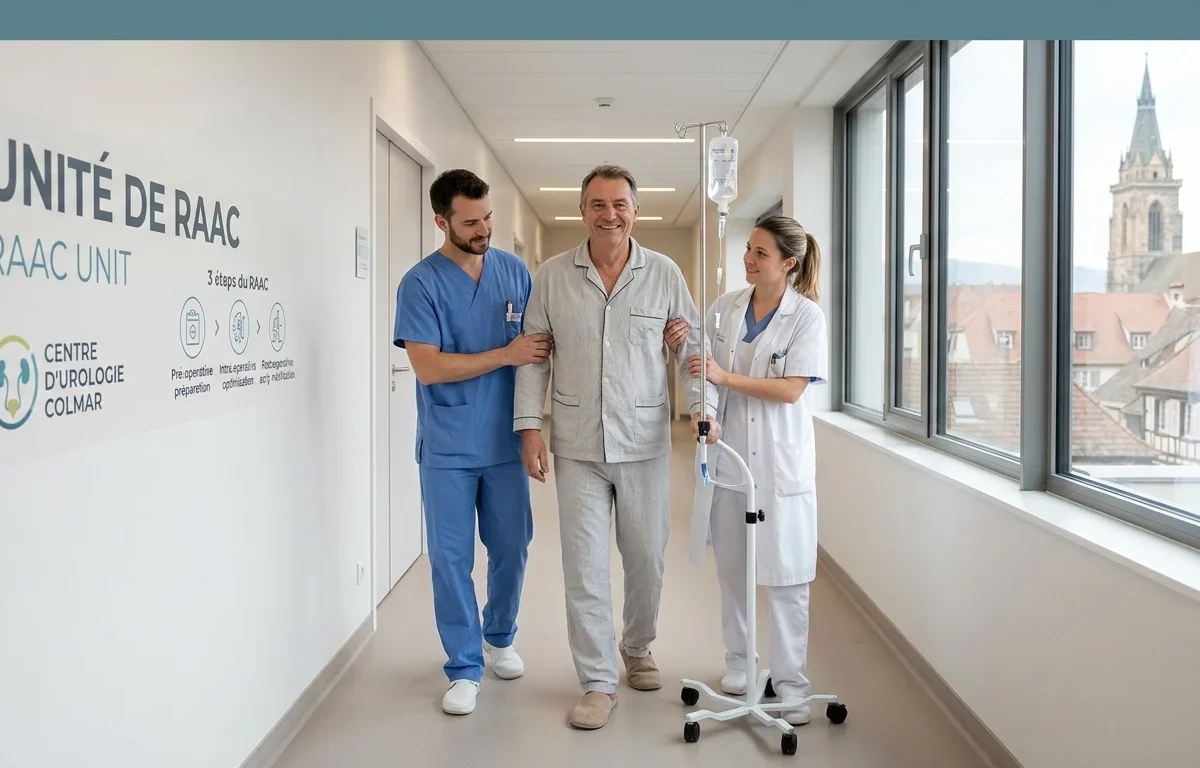
Urological Surgery: How We Help You Recover Faster (The ERAS Protocol)
11 June 2026

Urological Surgery: How We Help You Recover Faster (The ERAS Protocol)

Urological Surgery: How We Help You Recover Faster (The ERAS Protocol)

The thought of undergoing surgery often brings stress: fear of pain, long hospital stays, or a difficult convalescence. At the Colmar Urology Center, we implement an innovative method to transform this experience: ERAS (Enhanced Recovery After Surgery).

But what exactly is it, and how does it change your surgical journey?

Table des matières

1. What is ERAS?

Enhanced Recovery After Surgery is a multidisciplinary approach designed to minimize the surgical stress on your body. The goal isn’t just to get you out “faster” for the sake of efficiency, but because the better you recover, the sooner you return to your home environment, which significantly reduces the risk of infections and complications.

2. The 3 Stages of Your Recovery in Colmar

1. Before the Procedure: Becoming a Partner in Your Care

Everything starts long before you enter the operating room.

  • Information: A patient who knows what to expect is less stressed and recovers better. We walk you through every step.
  • Nutrition: The days of strict 12-hour fasting are over! Under the ERAS protocol, we often allow specific carbohydrate drinks up to 2 hours before anesthesia to ensure your body maintains its energy levels.

2. During the Procedure: “Gentle” Surgery

By utilizing the Da Vinci robotic system and laparoscopic techniques, our surgeons perform millimetric incisions.

  • Targeted Anesthesia: Our anesthesiologists prioritize protocols that limit the use of opioids, thereby reducing nausea and fatigue upon waking.

3. After the Procedure: Early Mobilization

This is the pillar of the ERAS protocol.

  • Early Movement: Just a few hours after surgery, with the help of our nursing staff, you are encouraged to sit up and take your first steps.
  • Quick Nutrition: You resume drinking and eating sooner to restart your digestive system.
  • Returning Home: Once all safety criteria are met, you can return home—often on the same day or the following morning—with coordinated follow-up care.

3. Why Choose the ERAS Path in Colmar?

By reducing time spent in bed and in the hospital, the benefits are clinically proven:

  1. Fewer Complications: A lower risk of blood clots (thrombosis) and hospital-acquired infections.
  2. Less Pain: Proactive and personalized pain management.
  3. Faster Return to Normal: A quicker transition back to your professional and social life.

A word from the team: “ERAS is a contract of trust between the patient and the medical team. The more prepared and active you are, the faster your body heals.”

Scheduled for Surgery Soon?

Feel free to ask any questions about the ERAS protocol during your next consultation at the Colmar Urology Center. Your comfort and safety are our top priorities.

I'm making an appointment

References and Sources (*)

  • GRACE (Groupe francophone de Réhabilitation Améliorée après Chirurgie).
  • HAS (Haute Autorité de Santé) – Recommandations sur la mise en œuvre de la RAAC.
  • Fiches d’information de l’Association Française d’Urologie (AFU) sur la chirurgie robotique.
read more
by Stéphane Pierrein Actu0

UROLOGY CENTRE OF COLMAR

39 Avenue de la Liberté, 68000 COLMAR

Free car-park / Disabled access
45 minutes away from Basel-Mulhouse and 55 minutes from Strasbourg

USEFUL LINKS

Colmar Civilians Hospitals
Uro France

 Rated 4.5 out of 5

RANKING “LE POINT SANTÉ” 2024

Prostate cancer : 10th out of 138 hospitals (overall score of 18,42/20)
Prostate adenoma : 3th out of 246 hospitals (overall score of 19,16/20)
Urinary calculi : 8th out of 269 hospitals (overall score of 18,30/20)
More details here

Colmar Urology Centre © 2024 – All rights reserved – Legal notice – Site improved and maintained by PS-Web

Wordpress